The Distance Between Brooklyn and Long Island

By Kayley Shanks 

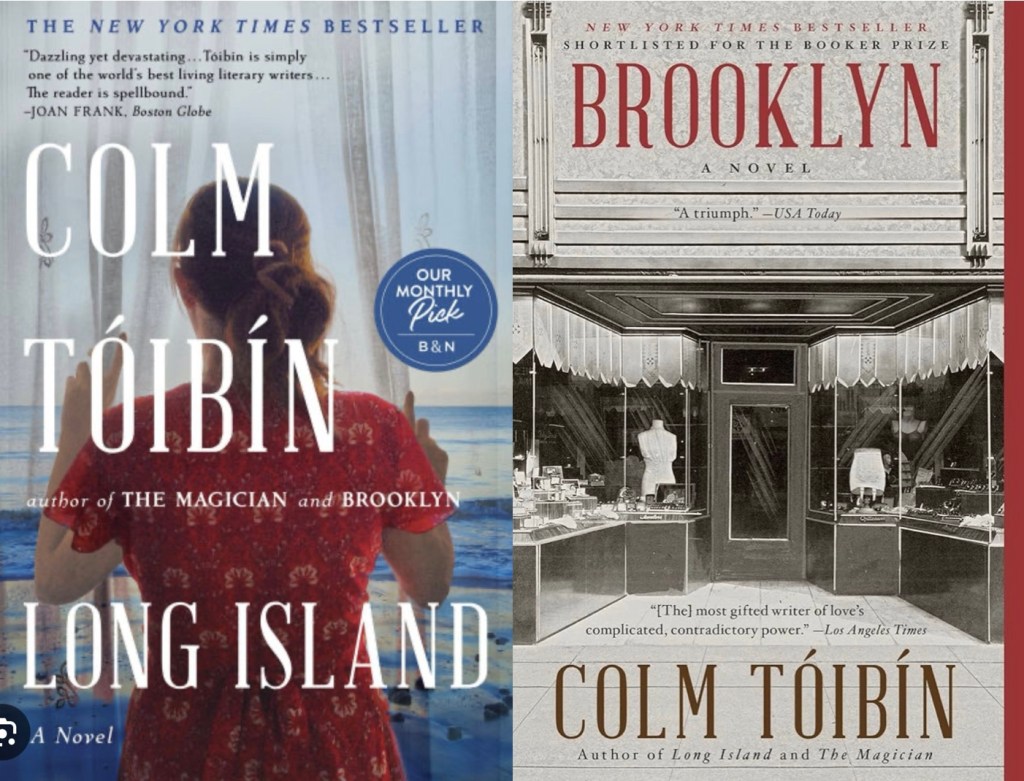
The world was first introduced to Eilis Lacey in Colm Toibin’s novel, Brooklyn. Eilis was a young woman living in Ireland during the 1950’s who, due to the lack of prospects for her future there, was urged to emigrate to Brooklyn. There she met Tony Fiorello, a young Italian native, and they fell in love. After finding home and comfort in a new place that had seemed so bleak and tragic, Eilis grew to love Brooklyn. That is, until the news of her sister’s passing came to her from across the sea. She returned home to Enniscorthy, sparked a new connection with a young man from home, and was unsure of what her future held. Ultimately, she decided to travel back to Brooklyn and to Tony, understanding that they were her new true home and that was the future she wanted. 

Fifteen years after that novel’s publication and twenty years after its events: enter Long Island, the sequel to Brooklyn. If you are a reader like me, and massively enjoyed Brooklyn, then I am sure we had a very similar reaction when reading this line on one of the opening pages of Long Island: 

“Indeed, he came back regularly when he knew that the woman of the house would be there and I would not. And his plumbing is so good that she is to have a baby in August.” 

How could so much have gone wrong? After meeting at a dance, going to the movies, a trip to Coney Island and much talk of raising children to be Dodgers fans (maybe the Brooklyn Dodgers no longer existing in the present could’ve contributed a bit to the negative turn), Eilis had wholly given up her life in Ireland to have a future with the man she loved and the place he had taught her to love. And then 20 years later all that disappears, and he cheats? 

The question remains: can we enjoy a novel whose events are categorically unenjoyable? Well, Toibin’s prose is always lovely. In both setting and character descriptions, his language is striking and seems to latch right on to you. He writes, “All of us have a landscape of the soul, places whose contours and resonances are etched into us and haunt us.” And when speaking of Eilis’ old connection from home, “It would be hard to explain to her how lonely he felt when he came into these rooms after closing time and how that feeling became more intense if he woke in the night or in the morning. He had not felt like this before the possibility of being with her arose.” 

The character Toibin has created in Eilis contains elements of all the women I know and love. He writes so convincingly and generously that there are parts of the story where the reader forgets the unfortunate opening and those trivial details looming over Eilis’ life, as she sometimes seems to as well, and we can be completely present with her. In each novel, Toibin’s descriptions of Ireland, both the land itself and the community held within, makes it feel to the reader as a second home, a place within an arm’s reach that we see and feel. 

I do not regret this novel. Its events make me angry and cautious towards the men in my life, but it is a beautiful piece of work regardless. When an author’s voice and creativity can shine through the most bitter stories, I consider them a lovely talent, and more than worthy of their place on my bookshelf.

The Shining: King’s or Kubrick’s?

by Kayley Shanks

         Have you ever anxiously anticipated the film adaptation of your favorite novel, only to be alarmingly disappointed when it came out? Do you refuse to watch the movie before the book? Adaptation has taken on a strange twist of artistic license and opinion among viewers, in a way that is very interesting. 

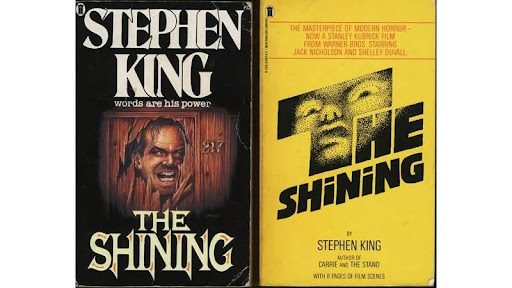
            One of the most famous examples of a polarizing adaptation would be The Shining by Stephen King, made into a film by Stanley Kubrick in 1980. When the novel was first published in 1977, it was wildly popular, being King’s first best selling hardcover and cementing him as an important figure in horror. However, nowadays when people refer to The Shining, they are usually speaking of the movie alone, which has taken on a life of its own and become almost a separate work of art. 

            The differences between the novel and movie are stark and obvious to any reader/viewer. Jack’s alcoholism that is a recurring theme throughout the novel is sidelined in the movie. Wendy’s fiercer attitude and sense of agency throughout the novel is largely taken away; it only seems to appear at the end of the film. The very carefully defined characteristics of Danny and Jack’s relationship were mostly erased from the movie; we see them truly interact only a handful of times. The ending specifically changes from the hotel burning down to freezing over. 

            King famously critiqued the film, saying the sense of his novel was very warm and the movie was cold. He called it a “maddening, perverse, and disappointing film” and described it as a “great big, beautiful Cadillac with no motor inside.” King also spoke at length about the character of Jack being as close to autobiographical as he had ever been in his writing. He believed that writing this alcoholic abuser as someone who had the possibility for a redeemable ending gave him closure in some way, and Kubrick’s erasure of the alcoholism and added decisive ending disrupted the emotional calm that King had achieved from writing the novel. 

So, we have two works of art that are connected yet slightly at odds. There can be no real measure of which one is better and there were certainly things lost between the page and screen, but it would be hard to be decisive on whether that damaged the integrity of the art. It also begs the question of whether an original author has final say over the story they created. Kubrick took King’s work and changed it in a way that damaged King’s original idea, but is that a violation or a reasonable artistic decision? Does it matter that King had personal ties to the work that were altered? Can we even view these works as separate? Is that unfair to the author?

As someone who has experienced and enjoyed both the film and novel, I take them as separate. I appreciate King’s writing and Kubrick’s visual storytelling, but I am sure that many people would take fault with that approach, especially King himself. 

Setting the Tone: How Music Enhances the Writing Process

By Nayeli Roldan

Music has an extraordinary power to evoke emotions, create atmospheres, and even influence our thoughts. For writers, harnessing this power can transform the writing process, helping to set the tone for their narratives and enhance the creative flow. Whether it’s the backdrop for a gripping scene or a catalyst for a character’s development, music can play a pivotal role in shaping the world of a story.

         When crafting a narrative, setting the right tone is essential. Music can serve as a guiding force in this endeavor. Different genres of music convey varying emotional landscapes; a sweeping orchestral piece can evoke grandeur and urgency, while a soft acoustic ballad may inspire introspection and vulnerability. By curating a playlist that reflects the mood of a scene, aesthetic of a character, or the overall theme of a story, writers can immerse themselves in the emotional undercurrents that drive their narratives. For instance, I’m currently working on a tense thriller scene for a short story and am struggling with how to move forward with it. I might opt for fast-paced, suspenseful tracks, creating a sense of urgency that mirrors the unfolding action, or I may focus specifically on one character and find a song that encapsulates their feelings. Conversely, when developing a romantic subplot, softer melodies can encourage a more reflective state, allowing the writer to explore deeper emotional connections between characters.

         Listening to music while writing can also stimulate creativity and enhance focus. Many writers find that background music helps drown out distractions, allowing them to dive deeper into their work. This practice can be particularly useful during moments of writer’s block. The right music can provide a spark of inspiration, helping to drive the plot forward and navigate through challenging sections of the narrative. Some authors prefer instrumental music, as lyrics can sometimes be distracting, while others—like myself—might opt for lyrics exclusively, as lyrics can sometimes serve as a guide in theme for a literary scene. Genres like classical, ambient, or electronic often create a sonic environment conducive to writing. These soundscapes can help writers enter a flow state, where creativity flows more freely and ideas coalesce seamlessly.

         Music is not only a tool used for inspiration; it can also aid in the practical aspects of writing scenes. By envisioning how a specific piece of music aligns with a particular moment, writers can enhance the vividness of their descriptions. For example, a climactic battle scene may benefit from the intensity of a cinematic score, guiding the pacing and tension of the writing. In contrast, a scene set in a serene garden may be enriched by soft, gentle melodies that mirror the tranquility of the setting. Additionally, music can aid in character development. The songs characters choose to listen to can reveal their personalities, motivations, and emotional states. A character who listens to upbeat pop may project confidence and positivity, while one drawn to dark, brooding music might hint at deeper struggles. These musical choices can deepen readers’ connections to characters and make their journeys more relatable. It could also just be a fun little project for writers to explore their world and better develop who their characters are, what the time period is, and what are the motives that drive their personality and decisions.

         Incorporating music into the writing process is a technique many authors use to unlock creativity and enhance storytelling. By setting the tone, fostering emotional depth, and aiding scene formulation, music can become an invaluable companion on the writer’s journey. Whether you’re drafting your next novel or polishing a short story, consider curating a playlist that resonates with your narrative. You may find that the rhythm of the music guides your pen as effectively as the rhythm of your words.

Exorcism Through Writing

By Ethan Luce 

Content Warning for Suicide

Many writers have an emotion they wish to exorcize. And many feel suffering can only improve art. But is that true? Vincent van Gogh was a tormented man, but one of the greatest artists of our time. The Bell Jar was an instant best seller, inspired by the author Sylvia Plath’s experiences with trauma and depression. Does art require suffering for success? For a long time I thought so.  

Many authors have thought of using their work as an exorcism of trauma or as a means of catharsis. But can it truly help? Memoirist Vicki Laveau-Harris noted that penning her Stella Prize-winning book The Erratics was not a cathartic experience, though she added that this is not the case for all authors. “For every memoirist who thinks as I do, there are many who feel the opposite: that writing a memoir should, and does, provide catharsis,” Harris said.1 

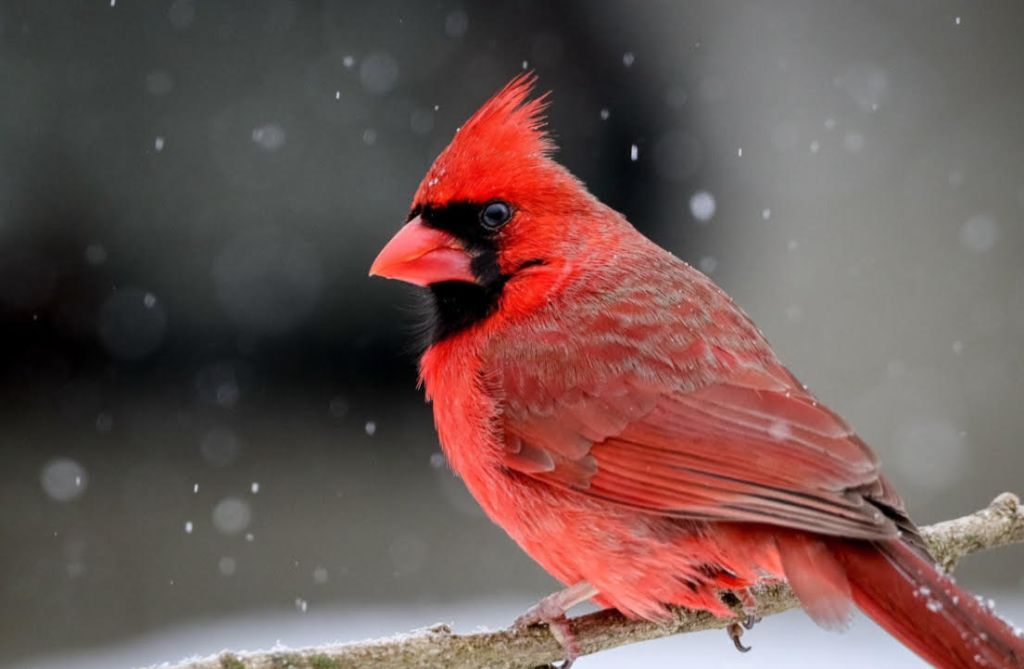
My grandfather once told me that cardinals carry the souls of the departed who come back to watch over you. I’ve thought about that a lot. I’ve thought of death, wondering if I’ll fly free like a bird. Would those shores be kinder, my family happier with my soul adrift? Many days, I’ve thought that when I meet the reaper, I’ll nuzzle my face against his billowing warmth, coming in waves like that of hot ocean water. I’ll forget my worries, and let loose my burdens. And then I’ll take flight.  

But is finding catharsis through writing fiction different? Delilah S. Dawson, in her essay “Revenge and Capitalism in Popular Media,” noted that writing revenge fantasies through fiction can indeed give the writer catharsis. As Dawson notes, often in life wrongdoers get away with all sorts of things, so doling out punishments in fiction can provide satisfaction.2 Fiction can be fair, but life never is. But what of the author’s own hurt? 

My grandfather grew up in a coal mining town in Appalachia. Kentucky, specifically. He was a warm man, always smiling. But he told me and my father before me never to become a coal miner, because that was one of the worst jobs of all. Where he grew up, the Great Depression never ended, and he carried that with him. He was a jokester and had the loudest laugh I’d ever heard. But he was always worried about money. He kept his Volvo for twenty years even when it spouted fumes. Whenever we went to McDonalds, he’d take as much ketchup packets as he could and shove them in his pockets. 

Jarred McGinnis noted that writing The Coward, a book based on his abusive childhood, was an incredibly cathartic experience. “People pay a lot of money for therapy, and I figured out how to get paid for mine,” McGinnis said. “Aren’t I a cleverclogs?”3  Horror author Zin E. Rocklyn noted that while they find the act of writing cathartic, they still make sure to give themselves aftercare once they’ve finished particularly draining and personal works. “Now, I focus on aftercare. […] Very basic things, which I still haven’t mastered, but I’m working on it,” Rocklyn said. “I battle several types of depression and PTSD, as well as general anxiety, so I have to make sure I take my meds and be aware of when I feel like I’m starting to spiral.”4 

I’ve quoted so many, but what can I say on writing as an act of catharsis? I have written many pieces myself, and I know of the myth of the suffering artist, that only our pain can create great art. I have felt deep pain. I have been hurt by others. I have felt isolated and alone and afraid. I am autistic, and in my youth I suffered from a skin condition that meant I could not sweat, and looked years older than I was. At twelve, I could be mistaken for eighty. That was not ideal in a society where you have to look perfect, and where people can be cruel when you can’t keep up. I was not alone; I had family who loved and supported me, and I found friends who did the same. I feel blessed to have them, but I still felt ashamed of myself, and turned hate inwards. I remain vague on this simply because there are things I do not wish to share, but I kept all of that inside because I felt it my duty, in some strange way. And perhaps it would help my art. Perhaps I would become a better writer through it. 

One member of my support network was my grandfather. I loved him deeply, and he me. After some years, however, he developed hydrocephalus. He struggled but he kept smiling. One day during mid-pandemic 2020, he committed suicide. There had been no warning signs. For several days, we could not even find a note. My entire family was wracked with grief, but after the initial period, I kept moving forward. Years later, when I took a creative writing class at Purchase College, I wrote a story inspired by this incident. My professor noted that the main character had obviously not processed his grief. And I hadn’t either, I realized. I had hoped to use pen and paper to ward grief off, but what I had to do was admit to it. I wept and cried, and finally leaned on my family. I told them what I felt, and I let that weight leave me. 

I wrote the pain into my stories as an exorcism when I felt I had no one else to talk to. And did it help? Of course not. I still felt the same way. No, what helped me was to reach out to my support network and try to work on my own mental health. Even now, I still struggle to stay above water. But suffering does not ennoble. It just exists, without purpose or significance. It doesn’t help make anyone special or better. It’s just suffering. 

Yet that shouldn’t mean you don’t have a right to be happy. The suffering artist is a popular myth, but it’s still a myth. My pain did not give the art I made a quality I could not have given it had I focused on trying to heal. Can your experiences help you write? Yes. But ultimately, it’s no substitute for therapy, or for turning to the people who support and care about you. No one does anything alone in this world. And you are not alone. Even knowing this, I sometimes still feel alone. When I feel that way, I look outside to see all that miraculous world. Sometimes when I do it, I see a cardinal.

BookTube and BookTok: How Online Book Communities Have Changed the Landscape of Reading

By Sydney Maria

People online can garner thousands—even millions (especially on TikTok)—of views for talking about books.

As someone who has spent years getting recommendations from other readers online, I understand the appeal of watching videos about books. It was one of the things that propelled my love of reading as a young teen, and sustained it into adulthood, even at times when I wasn’t an active reader.

I believe one of the reasons that bookstores aren’t obsolete (as so many people have postulated), is because of social media and how it has changed the landscape of book culture. People crave the tangible, especially in an increasingly digitalized world. While e-readers are still prominent because of subscriptions like Kindle Unlimited, a huge part of BookTube and BookTok centers around buying and collecting physical books.

In the early days of BookTube, bookshelf tours were extremely popular, and they still have an audience, but other types of videos have grown in popularity as well, like book unboxing hauls where viewers watch creators open boxes upon boxes of different books to sit on their shelves. The consumerist aspect of the book community is one that many people criticize, especially when purchasing from sites like Amazon rather than from independent bookstores. There is a very serious hivemind within the book community to emulate popular content creators: buying hundreds of books every year in order to keep pace turns reading into a competition. And when they fail to read the four or five books a week that content creators do, given that most people don’t make their living from being a content creator, they can end up feeling inadequate. This is a very real criticism of the way BookTube and BookTok commodify the reading experience. For most of us who grew up reading, it was never really about how many books we were reading. The stories were vastly more important than the quantity of books. What does it matter how many books you’ve read if they were all meaningless to you? Just to reach some arbitrary goal?

While there’s some substance to this criticism, there is also the flipside: some of this criticism feels rooted in misogyny since it pertains to the largely female audience of readers who enjoy fast-paced, light-hearted, and “easy” books. There is a common occurrence where things liked by a majority female demographic get criticized for being “bad,” “stupid,” or “mindless,” and it can be frustrating to see these same sentiments over and over again in the spaces I frequent and enjoy, especially when male content creators often garner ten times the views of their female counterparts. The women whose videos I’ve watched since I was a teenager, like PeruseProject, MelReads, and Jaime’s Library, were once young girls who found solace in discussing the YA, romance, and paranormal books that were seen as less than and they only have a fraction of the audience of their male counterparts. I don’t mean to discredit the content made by men in the book community, they have interesting and eye-catching video ideas, but it’s hard not to feel some disappointment seeing the different treatment a male creator gets in a female-led space. Still, these communities have encouraged more people to read. They have enticed people with thoughtful reviews and recommendations. Sure, many of the books recommended on these platforms, especially TikTok, are the same lists regurgitated over and over again, but sometimes it’s people’s first time hearing about these books. So, while these critiques can be made, as well as analyzed introspectively, I will always support exposing more people to reading.

Godzilla Returning to His Roots

By Alira Cohen

Monsters are important. You might laugh at this statement, but it’s true. I first realized this when I was eight years old watching the 1956 American cut of Ishiro Honda’s “Gojira,” a cautionary tale about nuclear war. In spite of the American cut’s obvious efforts to soften the blow of the message present in the original, eight-year-old me could still understand that there was something deeply disturbing about this monster movie. The images that director Terry O. Morse could not erase were those of children being scanned for radiation poisoning, cities devastated beyond repair, broken bodies lying in hospital beds. There was nothing that could have convinced me that this was a normal creature feature, and when I was told that it was a movie about Hiroshima and Nagasaki and told what that meant, everything started to make sense. The reason for Godzilla’s identity as a monstrous character was such: In the 1950s, Japan was under America’s watch in just about every sense due to the events of World War II. Honda wanted to talk about the bomb and the devastation caused by it, but in order to do so, he needed to be somewhat stealthy about it (though there were still a couple direct references to the bomb in the film). Therefore, instead of making a full-on war picture, he dressed it up in the skin of a monster movie, inadvertently creating the most influential monstrous character in film history. Unfortunately, the 1956 American cut, which neutered the 1954 original drastically by adding in an overbearing White main character that hadn’t been present in the film before, as well as amputating any even slight reference to the atomic bomb, did manage to leave a negative impact on Godzilla’s metaphor in the long run. It was aided by the almost immediate Japanese sequel to 1954, Motoyoshi Oda’s “Godzilla Raids Again,” which was by far an inferior film that centered around a monster fight rather than a message about nuclear war. Realizing that making Godzilla a more simple movie monster would bring in the big bucks nationally as well as overseas, filmmakers strayed away from the original metaphor in favor of monster battles and weightless destruction scenes. With the exception of a few gems (which still miss the mark in their own ways), this has been the pattern that the Godzilla franchise has unfortunately continued to go by for years. However, one very recent film seemed to break that pattern. 

“Godzilla: Minus One” by Takashi Yamazaki was marketed in both Japan and America as an official attempt at an authentic remake of Honda’s “Gojira.” What immediately stood out about the trailers was the apparent setting of 1940s Japan, as opposed to modern day or 1950s Japan. While “Gojira” got incredibly close to the subject of nuclear war, the film that Yamazaki promised would directly touch upon it. Trailers and TV spots for the film depicted destruction that was both deeply horrific and intimate, showing closeups of characters suffering and trying desperately to escape the rampaging beast. I made predictions about the film before seeing it upon its release in theaters; I believed that it would be the first Godzilla film to be truly brave about its subject matter, and show destruction in a way that would be as realistic as possible for a PG-13 movie. I’ve now watched the movie twice, both times in a theater, and I can safely say that my predictions and expectations were extremely close to the final product. I don’t want to go into spoilers so I will write about the subject as carefully as I possibly can to avoid doing so. What I can discuss, however, are themes. “Gojira” strikes me as the traumatized reaction of a man who had seen war and devastation so closely, but he couldn’t say everything that he wanted to say. It was Honda’s reaction to nuclear war but through a filter. “Minus One,” comparatively, strikes me as a reflection on the horrors that Japan faced…and not only this, but how the Japanese government handled the war.  The main character of “Minus One,” Shikishima, is a disgraced kamikaze pilot who fled his mission. Godzilla, as a result, represents his guilt, and seems to follow him throughout the film. Shikishima isn’t treated as a villain by the script. Instead, he is treated with compassion and extreme empathy. Ultimately, he needs to learn that self-sacrifice isn’t exactly the noble thing that the government would like him to believe that it is. The film discusses how the government of 1940s (and earlier) Japan had little regard for the young men that it sent off to war. I have to say, this was the part I wasn’t expecting. The original “Gojira” possessed elements of glorifying self-sacrifice, though admittedly it did fit the theme and made the film better, but “Minus One” feels like a bold answer to that. In terms of what I was expecting, “Minus One” is a more detailed version of “Gojira.” There are scenes that appeared in the original “Gojira” that are more intimately examined in “Minus One.” We see the characters’ suffering up close, which is exactly what I believe the franchise desperately needed. Even Godzilla himself is in pain, and it’s very clear. He lumbers in a way that is slow and unnatural. He moves as though he hasn’t been able to adjust to the changes that have happened to his body. Every time Godzilla was on screen I, a Godzilla fan of many, many years, felt intense anxiety and I wanted him to go away. This, in my opinion, is the biggest sign of a monster movie done right. After watching the movie for the first time, it made me want to go back and continue working on my own monster-focused book immediately.  

America seems to have had a massive reaction to “Godzilla: Minus One.” The movie remained in American theaters for far longer than it was intended to because of this. It received great praise throughout the country, and I’m seeing that this is causing Godzilla to be taken seriously again, at least to a certain degree. If anything, it is causing Americans to take monsters seriously again, which is very good news for someone like me. I have always had a fascination with writing monstrous characters, and writing them with purpose. It is a theme that I plan to stick to quite loyally as a writer, because I am of the opinion that many things can be done with monstrous characters. I feel as though “Godzilla: Minus One” proves this. Monsters are frightening, but they’re also frightened beings who don’t have much control over their own fates. Godzilla was the character that made me want to write about monsters in the first place, and now he is giving me that inspiration again as a twenty-two year-old. My favorite part of watching “Minus One” in a theater (the theater that I work at when I’m home, actually) was seeing my sister’s rather large reactions to many of the scenes. She has never been a big Godzilla fan, so this meant a lot to me, and reassured me that monsters can transcend the trappings of the horror, fantasy, and sci-fi genres to emotionally impact people who usually don’t care for such things. If done right, that is. And Yamazaki, in my opinion, did it perfectly. I truly do recommend that anyone reading this see “Minus One” at least once in their life, especially if you are a writer who is interested in writing monstrous characters or disaster pieces. Hopefully now, with the existence of this film, people will begin to realize that Godzilla is much more than a scaly MMA fighter, and monsters provide more than empty entertainment. I want to thank Yamazaki for rejuvenating my optimism about the future of monstrous characters, and I hope to be seeing some great projects come out as a result of this.  

Virginia and Vita: Star-Crossed Lovers in Literature


By Kay Mancino

Have you ever read a book by Virginia Woolf? Your professor may have handed you a copy of The Waves and asked you to write a five-page paper. Maybe you stumbled across Mrs. Dalloway in your hometown library and decided to pick it up. Perhaps you watched the film Orlando because you loved Tilda Swinton and realized it is based on a novel written nearly a century ago. No matter how you discovered Woolf’s writing, you can’t ignore the distinct imagery or subtle hints at underlying motifs: grief, loss, heartbreak, gender, and love.  

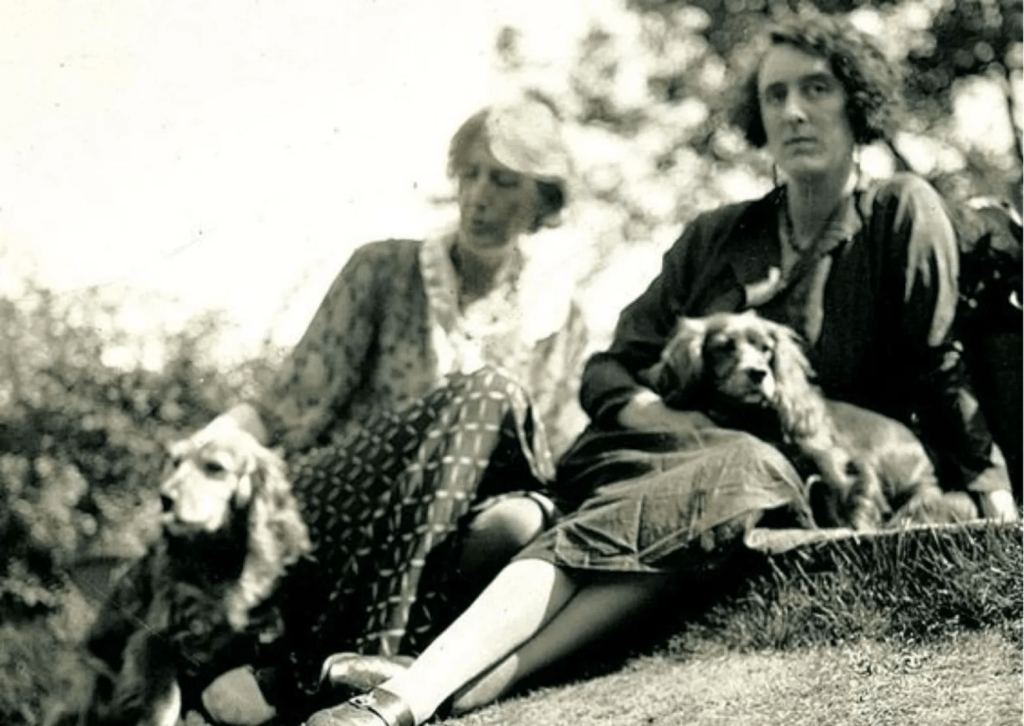
Born in 1892, Woolf explored the depths of feelings that were not often written about by female authors. For example, Orlando, published in 1928, featured a main character who switched genders from male to female. Woolf details the struggle that Orlando faced upon living as a newfound woman; unless she was married, she would lose her estate. The novel strikingly shows the power imbalance between men and women through prose which resonates with audiences of all ages and time periods. What most people don’t know is that Orlando is based on a real story and woman: Vita Sackville-West, Woolf’s long-time lover.  

Sackville-West, another novelist, lost her childhood estate in Kent due to her gender. Because she was a woman and the estate must be inherited by a man, she could not inherit the Knole house. Woolf wrote Orlando in order to provide Sackville-West an alternate ending, as Orlando ends up inheriting her own estate at the crux of the novel. Despite both Woolf and Sackville-West marrying men, their relationships were open. The two women met at a costume party in 1922 and remained lovers for over a decade, exchanging letters back and forth. Sackville-West’s son, Nigel Nicholson, addressed Orlando as the “longest” love letter of all time.  

Upon the publication of Orlando, Sackville-West wrote to Woolf, “The lesbians are rising throughout the States/ All because of you.” Woolf and Sackville-West’s letters were gathered and published within the collection, Love Letters, in 2021. Alison Bechdel, the author of Fun Home and creator of the “Bechdel Test,” wrote a forward for the collection. Despite the deaths of both women— Woolf from drowning and Sackville-West from cancer— their love has lasted throughout the century through the use of language and words. Woolf’s novels garnered inspiration for queer women, her icon becoming a staple for the community. The exploration of gender and identity throughout Orlando was a direct reference to Sackville-West and her challenge of societal roles.  

If you have ever read a novel by Virginia Woolf, you might not have expected to relate to her words and images so wholeheartedly. But at the end of the day, despite the passing of time, Woolf was a woman in love, with Vita, with literature, and with the mystery of what emotions can bring to life through the use of words.  


On Commonplace Poetry


By Cydni Thompson

“Full of beads and receipts and dolls and  

cloths, tobacco crumbs, vases and fringes.” 

Gwendolyn Brooks, “The Bean Eaters”


What defines the average life is a series of routines, mundanities, and commonplace objects. What life does not include a phone, a bed, a faucet, a blanket, a house; the filth that accumulates by the simple exertion of living, and then its cleaning? And while some may believe that poetry should eschew these most ordinary happenings, I, like many, argue that the commonplace aspects of our lives are significant, and fodder for poetry, whether the poem glamorizes these truths or lavishes in their plainness, it’s through the ordinary that the poem can transform. 

Gwendolyn Brooks produced a body of work focused on the sheer normality of Black life. In the poem “I love those little booths at Benvenuti’s,” Brooks assumes the perspective of a white group travelling to Bronzeville (a Black neighborhood) to observe Black people in a restaurant. They are expecting to see something animalistic; they are looking for a spectacle, an extraordinary sighting of those mythic Blacks in their famous ghetto. They are disappointed. Brooks ends the poem: 

The colored people arrive, sit firmly down,  

Eat their Express Spaghetti, their T-Bone steak,  

Handling their steel crockery with no clatter,  

Laugh punily, rise, go firmly out the door. 

Note the generic verbs: “arrive,” “sit,” “eat,” “laugh,” “rise,” “go,” and the specificity given to common food: “Express Spaghetti” and “T-Bone steak.” These words have no connotations, and are used to describe all groups of people. This explains in necessary detail the ordinariness of these Black people, which symbolizes their humanity. One function of using the commonplace in a poem is connection between humans on the basis of our shared banality; we sit, we eat, we leave. Strategically, Brooks uses these commonalities to shame the racist group whose spectatorship had dehumanized the Black patrons. 

Another poem which uses the ordinary to interrogate racism, specifically colonialism, is Lorna Goodison’s “Reporting Back to Queen Isabella”. This poem follows a colonizer reporting to his Queen the treasures he’s found in Jamaica: “high mountain ranges, expansive plains, deep valleys…” The vast extravagance of these natural wonders is juxtaposed at the end with the line: “and yes, your Majesty, there were some people.” In comparison to the beautiful landscape descriptions, this last line is unadorned and plain; the people are “some,” and unspecified. The ordinary language is used to expose the underlying sentiment carried by the colonizers–––that the land is gorgeous and valuable, and the people are of no consequence.  

The commonplace can also be used to embellish the lives of the working class. Philip Levine’s poem “An Ordinary Morning” begins, “A man is singing on the bus / coming in from Toledo.” Already the speaker is in an unadorned place, the bus, hearing something we’ve all heard before. Eventually, the passengers being to sing together, an unnamed song about love (“love that is true, of love / that endures a whole weekend,”) and hardship (“O heavy hangs the head,”). These abstract emotions occur to all humans, and so all the passengers can relate. This connection between people, this instance of singing, causes the speaker to look at his surroundings in a new light. By the end, they are not simply passengers, but “the living / newly arrived / in Detroit, city of dreams, / each on his own black throne.” They have been transformed into royalty; the seats are thrones, Detroit is full of dreams, and they’re only just arriving. Levine has not eliminated the normality of the bus in Detroit, but has chosen to frame it in a different light. The “ordinary morning” is made extraordinary through song.  

Rita Dove is another poet who sees possibility in the everyday. In “Dawn Revisited” Dove writes: 

Imagine you wake up 

with a second chance: The blue jay 

hawks his pretty wares 

and the oak still stands, spreading 

glorious shade. 

Here, the hawk of the blue jay and the shade of the oak tree constitute “a second chance,” though these are stimuli one experiences nearly every day without fail. Later, Dove ends the poem romanticizing a routine: “You’ll never know / who’s down there, frying those eggs, / if you don’t get up and see.” This poem situates the commonplace in the world of hope and wonder: how “glorious” the shade, how “pretty” the jay’s wares, how wonderful the mystery of the egg-frier. The implied notion is that these sensations are special because they belong to the living, a sentiment found a year earlier in Marie Howe’s famous poem “What the Living Do”. Addressed to the poet’s deceased brother, the poem opens: 

Johnny, the kitchen sink has been clogged for days, some utensil probably fell 

down there.  

And the Drano won’t work but smells dangerous, and the crusty dishes have piled 

up 

waiting for the plumber I still haven’t called. This is the everyday we spoke of. 

There is a gratitude in this poem as there is in “Dawn Revisited”, although it is for the everyday inconveniences rather than the birds and trees. The fact that the poem opens with a name of the dead means that all following details exist in contrast to death; in this case, they are a celebration of life, the clogged sink and crusty dishes alike.  

There is value in the universality of these, as there is in the poem “I’m Not Faking My Astonishment, Honest” by Paige Lewis, in which the speaker says: “A woman huffing up the trail behind / us says to her hiking partner, It wasn’t my size, / but it was only 9 dollars. And now all I want / is to see what it is.” There is an emotional weight to the ubiquitous overheard conversation, to the mutual recognition of a good deal, even between strangers. It is in moments like these that we see the poetic value in every second of our lives. The strategic use of specific verbs, embellishment and stripping down, the inclusion of the gross and the arbitrary; all these make for an authentic poem, a poem that exists in real life, on the ground, everywhere you look. 


Leave a comment

Historical Fiction: Writing What You Don’t Know

By Rachel Garrison

Sometimes it’s because of an assignment, and at other times it’s a wandering fascination, a slight pull, a spark from a corner of your heart: to write about what you do not yet know.

The question is how?  As young writers, we are taught in high school to write what we know as a way to add particular detail and avoid abstraction. The problem: this is meant as a springboard to learning craft, but not to be relied on as we grow as writers. Relying exclusively on life experience has apparent limitations, particularly when one wants to write about a different era. So how the heck does one write about a historical period long removed from one’s own, especially when there are no primary sources?

Cassandra Clare lived this experience when writing her bestselling series, The Infernal Devices. Having only visited London in the modern day, she knew nothing about placing characters in the late 19th century. To write characters placed nearly a century and a half ago, Clare read nothing but Victorian literature for six months- in addition to walking around London with a map from 1879. She described the process as “research by immersion,” ensuring that the historical novel’s details were as accurate as possible.

Experiences vary from person to person, but writing fiction—no matter the genre—always starts with the same question: what if? The initial springboard is rather similar no matter in which era your fiction is set. Without overselling it, the most important step is research. The History Quill emphasizes the importance of thorough research in a blog entitled, How to Write Historical Fiction in 10 Steps in order to avoid embarrassing anachronisms. Nobody wants to see Starbucks appearing in 18th-century South America (it was founded in 1971.) To avoid this kind of situation, decide on a time and start your research. Look at different sources: firsthand accounts such as letters or newspapers; documents detailing technology of the time, such as maps, fashion catalogs, or agricultural handbooks. To avoid historical anachronisms, utilize sources such as National Museums Liverpool and Crow’s Eye Productions that provide accurate guides on the everyday fashion of the past centuries.

However, don’t let yourself be scared off by the amount of research involved with writing historical fiction. Utilize gaps in historical records for the purpose of your narrative, fitting your characters into the missing pieces- as long as they’re explained in a historical note at the end.

Remember that fiction, even historical fiction, is an exercise in imagination. While it’s important to get the historical details right, the character’s journey is by far more compelling. So don’t be afraid of taking a step outside what you know. Push the boundaries a bit at a time and write what you have no experience with; it’s how you learn!


Writing the Memory of the Never-Happened

By Kirry Kaufer

Many writers are daunted by poetry. I used to be one of these writers, too. I used to think poems had to be vulnerable and confessional. However, poetry is different from nonfiction. In a poem, writers can dramatize their memories while remaining true to the authenticity of their experiences. As the poet Billy Collins once said: A poem is a memory that never happened.

Memory shapes who we are. Memory is a multitude of stories which show where we come from and how we approach our current lives. It is more fleeting, but less flexible, than imagination. Each time we reflect on a memory, it changes. We reinterpret them, retell them, and reshape our past experiences to resemble our present more effectively. In writing, a poem should allow for a memory to be recast, reimagined, or to be told in fragments. We can be as vulnerable as we choose if we play with memory as we do in fiction. Memory is an introspective art. It is a tool that explores the human experience, and makes tangibility out of the ephemeral.

In poetry, writers sometimes explore their memories by recasting themselves as a “persona.” Persona poetry is a style of poems in which the writer speaks through an assumed voice to mask their truths. The assumed voice can belong to a character, a historical figure, or another person the writer knows. Using this identity, they relive memory through a new lens. Here is a writing prompt to help you get started, inspired by the writing exercises from Christopher Castellani.

The Prompt:

Make a list of four “firsts” in your life. Then skip to “thirds,” “sixths,” or “lasts,” in order to jump around through memories. Examples may include:

  1. The first time you failed a test
  2. The first time you got a pet
  3. The first time you snuck out from home
  4. The first time you attended a concert
  1. The third time you went on vacation
  2. The last time you hung out with a friend before the friendship ended
  3. The last time you apologized to someone
  4. The last day of your second year in high school

Let the moments marinate in your mind for a few days before writing them down. Try to remember all the details of the memories and recast the identities of all the people. Use a variety of these moments in your poem. Scatter the memories across different lines. See if the finished poem retains its truth, while also being a memory that never happened.